Author Archives: Super Foodie

Unknown's avatar

About Super Foodie

Hi all and welcome to Super Foodie – a culinary adventure showcasing a super wholesome dish or drink that I’ve enjoyed creating or an activity or product that is so good, I just had to share. Every post will detail how to make the “food star” and why it is so good for you. Super Foodie crosses counties and continents to bring you the best and brightest super foods from New Zealand and around the world. Make 2016 a year for good times, super food and an enlightening adventure. Emily x

* Goat Cheese, Figs and Walnuts with Drizzled Honey *

Standard

Greetings from Woolpit in Suffolk, England! We’ve recently arrived here after a ten day adventure in Norway, where we had a memorable time with wonderful friends, old and new.  Norway is such a picturesque country, the people are gracious and the food is superb.  I’m feeling very inspired about the local delicacies that I’ve been devouring in Norway and here in England and I’m super excited about getting back into my own kitchen in Dunedin, New Zealand and concocting some deliciousness. I’ve been dreaming about being reunited with my food processor and making all of the dishes I’ve not been able to make on this trip without it. Living in many different abodes over the past three months has really made me appreciate exactly how good my kitchen is back home and what is essential, which has consequently been a good exercise in being truly grateful for all that I have, bless. We have another week here in the Northern Hemisphere and I’m savoring the fresh autumnal produce before I get to enjoy the spring delights of home. So much to look forward to – hurray!

The air has been feeling very autumnal here in Scandinavia and England. Leaves are fluttering about the paths and the evenings are fresh, as the summer dream is over for another year. As saddening as it may be that the warmth of the sun has dissipated, autumn brings with it an array of fresh fruit and vegetables which are very dear to many. Figs are one of my absolute favorites and have arrived at the markets, which makes me very, very happy. Ecstatic even.

Figs are the shining jewel in the autumnal crown. A fruit like no other, their taste and texture is very unique. As you take a bite, the chewiness of the skin, the crunchy popping of the seeds, the luscious flesh and the saccharine sweetness exude one great whack of sensory indulgence. In addition to tasting amazing, figs also get the Super Foodie tick of approval as their health benefits are many. Figs are an excellent source of dietary fibre, which assists in keeping you full for longer, which is good news if you are trying to lose weight especially as they are low in calories. The high fibre content in figs is also beneficial in keeping your bowels in tip-top shape and works wonders in relieving constipation. Figs are a good source of potassium, which helps to control blood pressure and also calcium, which assists with increasing and maintaining bone density. Figs also contain magnesium, copper, iron and manganese for an additional dose of goodness.

When purchasing figs, select those with a deep colour and which feel plump yet tender and ensure that there is no bruising.  As figs are highly perishable, keep refrigerated, wash right before you are about to serve and eat within two days of purchasing to ensure they are at their absolute best.

I love to eat figs simply on their own or with some Greek yoghurt, honey and nuts. However, the ultimate figgin’ combination is this one – a fragrant goat cheese (or chevre, as it is called in some places), the freshest, juiciest figs that you can find at your local market, walnuts and nectarous honey. Food of the gods, I say.

Goats Cheese, Figs and Walnuts with Drizzled Honey

200 grams of ripened goats cheese

4 large figs, quartered with stalks removed

16 walnut halves

Liquid honey, preferably raw

Fresh herbs to garnish

Cracked pepper

On four plates, drizzle a small portion of honey in the middle of each of the plates.  Cut the goat cheese into four slices (50 grams per person) and place on the drizzled honey. Arrange the quartered figs and walnut halves on the plate.  Drizzle more honey on top of the goat cheese, garnish with fresh herbs and season with cracked pepper.

Serve immediately. Vel bekomme!

* Chocolate Avocado Mousse with Raspberries and Candied Almonds *

Standard

Surely if there was a “Land of Chocolate”, Germany would be it (insert mental image from The Simpsons episode where Homer frolics around an imaginary German land made entirely out of chocolate here).  Chocolate appears everywhere in Germany, bright, alluring packets lining the aisles of supermarkets, corner stores and delis.  And my goodness, is it devoured – on buses, on the tube, biking down the road whilst talking on the phone, hiking in the hills – it seems it’s always a good time for a wee stück of chocolatey goodness.  Germany is one of the highest consumers of chocolate in the world and it is heavily engrained in German culture. It is also widely known that some kids grow up thinking that cows are actually purple after years of exposure to the purple Milka Chocolate cow.  In actual fact, the average German will eat around 11 kilograms of chocolate a year – meine Gute, that’s a whole lotta chocolate.

Chocolate has received a great deal of press in the past few years as research has unfolded just how high the levels of antioxidants are in cocoa, which you can read about in my recipe for chocolate spice bliss balls.  However, if you would like to go one step higher on the superfood-o-meter, raw cacao is the crème de la crème.  Raw cacao is one of the most beneficial superfoods that you can eat, it’s the cacao bean in it’s purest, most wunderbar form, containing iron, calcium, fibre, potassium and zinc.  Raw cacao is high in antioxidant flavanoids, which can help improve circulation and blood pressure. It also contains high levels of magnesium, which is one of the most effective minerals to combat stress, as well as building strong teeth and bones.  Raw cacao also promotes the release of neurotransmitters, which in turn release hormones that make you feel pretty fine and dandy.  One of these neurotransmitters, serotonin, can aid in reducing depression and combating PMS symptoms – what a superfood wunderkind!  The bonus is that by making your own chocolatey treats, you have absolute control over what you are putting into your mouths and can keep it as pure and unrefined as it was originally intended.

Chocolate mousse often conjures up thoughts of über-decadence, a bloated stomach and the goddess of all things domestic, Nigella Lawson.  In a typical chocolate mousse recipe, the main ingredients are cream, sugar and chocolate, which is such a feisty combination that it’s no wonder you feel like a nap afterwards.  However, with this chocolate avocado mousse, you get maximal health benefits with an intense chocolatey hit, without the post-dessert-too-much-dairy slump.  It’s sugar-free, dairy-free, gluten-free, vegan (when using agave) and can also be raw, providing raw honey or agave is used and that the almonds are kept in their natural state.  This dessert is also textural sensation – the tart raspberries, mixed with with the creamy chocolate mousse and lightly-spiced candied almonds is a superfoodie winner. Do it do it.

Raspberry and Chocolate Mousse with Candied Almonds

Two ripe avocados

Two tablespoons of raw cacao powder

Two tablespoons of coconut oil, softened

Two tablespoons of raw honey or agave

One teaspoon of vanilla paste/extract or a vanilla bean

A pinch of Himalayan rock salt

1/2 a cup of milk of your choosing (almond, hazelnut, dairy, rice, oat, etc)

1 1/2 cups of fresh raspberries

Fresh mint to garnish

Candied Almonds

1/3 of a cup of almonds

One teaspoon of coconut oil

One tablespoon of raw honey

1/4 of a teaspoon of cinnamon

Spoon the avocado into a bowl, blender or food processor*.  Add the raw cacao powder, softened coconut oil, raw honey or agave, milk, vanilla and salt.  Mix until smooth.  In a bowl, lightly mash about half of the raspberries with a fork.  Layer into small glasses, alternating the mousse with the mashed raspberries and the whole raspberries as you like. Allow to cool in the fridge for at least 30 minutes before serving.

Toast the almonds for a few minutes in small frying pan until lightly crunchy.  Add the coconut oil and toss around in the pan for another couple of minutes.  Add the honey and keep the almonds moving around the pan until a light caramel color is reached.  Take off the heat, add the cinnamon and stir well.  Transfer to baking paper and allow caramel to set.  Once hardened, break up the candied almonds, sprinkle over the mousse, garnish with mint and serve.

*  If you don’t have a food processor or blender, use a whisk and watch your guns grow.

Serves 4

* Watermelon, Halloumi and Rocket Salad with Tamari Toasted Pepitas *

Standard

I feel pretty damn lucky to be able to experience the best of the summer seasons in both the Northern and Southern Hemispheres and really do make the most of the summer provisions. Currently at the markets, nectarines, plums, peaches, melons, berries and avocados are all in abundance, so I’m happily concocting delightfully fruity combinations like this summery salad to share with you here in the warmer climes.  For those in the deep south, summer is just around the corner, so sit tight and watermelons will soon show their bright faces again.

Watermelons are peaking right now here in beautiful Berlin – juicy, sweet and oh-so-lecker, I just can’t get enough.  Watermelon really is the bees knees.  It is a super satisfying fruit which quenches thirst, the perfect fodder for cruising down the canal in a blowup rowboat on a bright, sunny day.  It is an excellent source of vitamin C, which assists the body in fighting infection (a bonus if you happen to fall in the canal).  It is also especially good for men as it has a generous dose of lycopene, a cartenoid which not only assists in keeping the prostate gland in tip-top shape, it is also beneficial to cardiovascular health.

As you may know, I’m staying in Neukölln, a highly eclectic area of Berlin with an array of cultural diversity and naturally, all of the foodie delights that come with it.  In actual fact, it seems that anywhere in Berlin you can’t swing a shopping basket without hitting a Middle Eastern kebab shop, Greek restaurant or Turkish supermarket. If I’m eating out, one of my favorite dishes has to be anything with fried halloumi, whether in a kebab with felafel or as the pièce de résistance atop of a salad.  Fried halloumi is something of a revelation for me.  I’ve only recently discovered just how easy it is to cook this “squeeky cheese” and how it is the perfect accompaniment to so many things, as the salty richness lends itself perfectly to the sweetness of fruit and sweeter vegetables like capsicum, tomato and beetroot.  It also provides a hearty dose of calcium which is fundamental to bone development, plus protein which is good for rebuilding muscle after a strenuous day rowing. Due to the robust texture and strong flavor of Halloumi, a little really does go a long way, so it’s possible to cut down on the high fat content and earn extra health points by reducing calories from fat where possible.

So, celebrate the last of the summer sun by grabbing your paddles and heading out on the canal for an afternoon of swan spotting whilst devouring this lush salad.

Watermelon, Halloumi and Mint Salad with Tamari Toasted Pepitas

200 – 250 grams of Halloumi

Olive oil for frying and drizzling

1/4 of a cup of pumpkin seeds

A tablespoon of tamari

1 kg of the brightest watermelon you can lay your hands on

A handful of mint leaves, plus extra for garnishing

A large bunch of rocket

The juice of half a lemon

Ground Himalayan rock salt and cracked pepper to taste

Heat a frying pan to a medium temperature and toast the pepitas until lightly browned, moving them around the pan often.  Coat the pepitas in tamari, remove from the heat and transfer to another dish to cool.

Wash and dry the pan and place back on the heat.  Add a good glug of  olive oil to the pan and allow to heat.  Cut the halloumi into small slices (about 1/2 cm thick) and place in the pan.  Fry until golden brown and flip over to brown the other side.  Remove the rind of the watermelon, cut into rustic pieces and remove the seeds where possible.

Arrange the rocket, mint, watermelon and halloumi onto a large serving plate or smaller individual plates.  Mix the lemon juice with a good glug of olive oil and drizzle over the salad.  Sprinkle with tamari toasted pepitas and season with Himalayan rock salt and pepper. Serve immediately while the halloumi is still warm.  Guten Appetit, meine Lieblings!

Serves 4


* Sprouted Quinoa, Pistachio and Pomegranate Salad (Raw) *

Standard

Happy World Raw Food Day!

Today is a celebration of raw food here, there and everywhere.  World Raw Food Day, or Weltrohkosttag as it is called here in Germany, is about inspiring people to eat more raw and gather together for a raw food picnic, potluck or elaborate feast.  Here in Berlin, there are many events happening überall; a massive potluck in Alexanderplatz, virtual potlucks online, picnics in random parks and raw food demonstration classes (un-cooking classes, if you will) by leaders in the raw food industry.

I’m a huge advocate of eating a mainly plant-based diet, which is high in fresh fruit and vegetables, legumes, whole grains and super foods and I feel pretty, pretty good.  I aim to eat a bright rainbow of goodness every day and make an effort to eat raw where possible.  By adopting a plant-based diet, you are supporting your overall health and well being by accessing the nutrients you need to feel fighting fit and fabulous.  In keeping food raw, you are retaining those nutrients that may be lost during the cooking process, as well as the vitamins, minerals, proteins and enzymes that can also deplete.  By making the decision to keep some of your food raw, you will be doing your body some serious good.

A very dear friend of mine, Kauia, is also a big fan of raw foods and has been most informative and inspiring.  You can check out her blog for some further raw power inspiration.

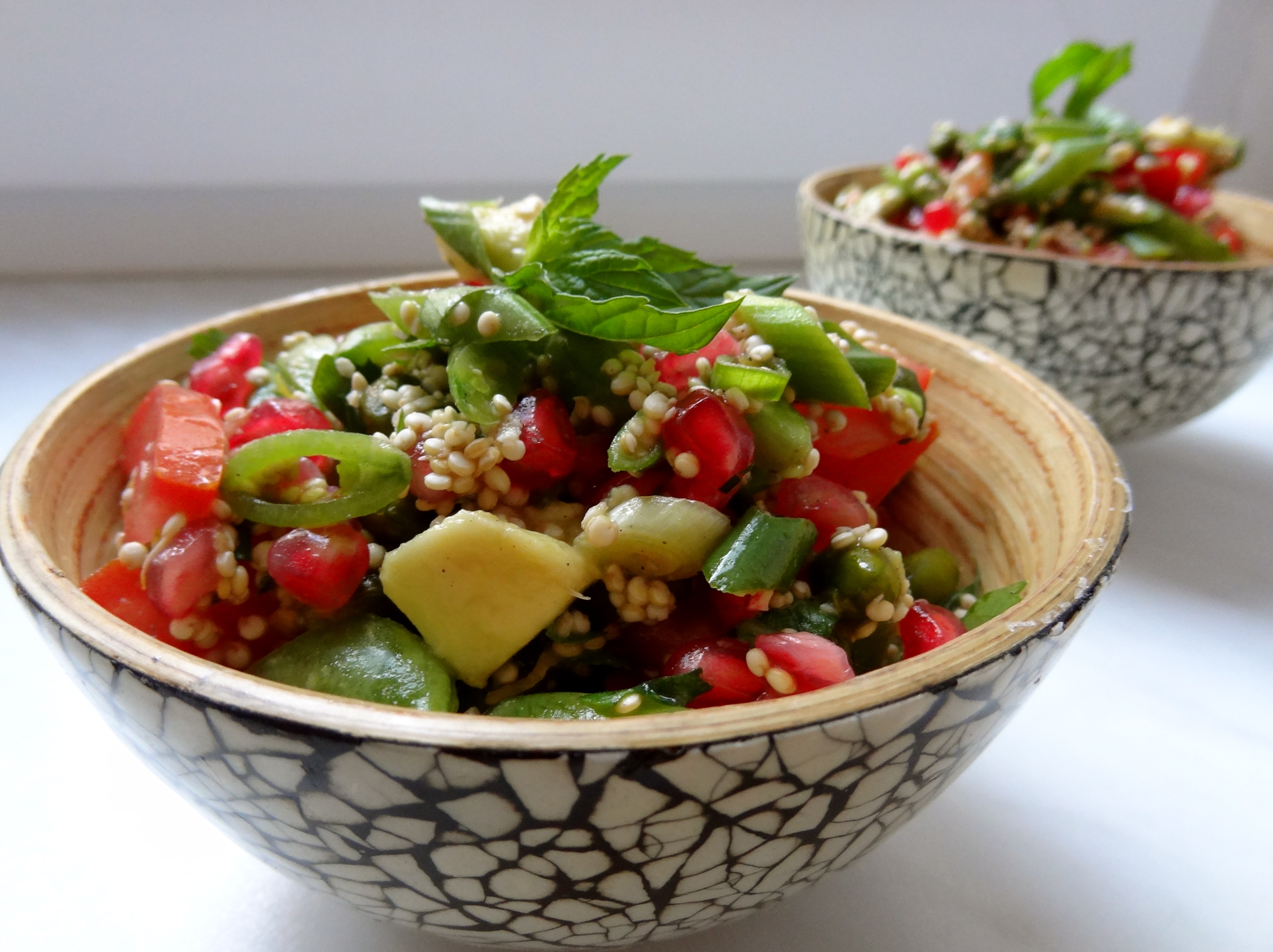
This salad is the epitome of a 100% raw food celebration.  The sprouted quinoa is a shining example of pure, healthy goodness as through the sprouting process the natural enzymes are activated, it is easier to digest and the vitamin content is boosted.  In this salad there are some interesting flavors and textures going on, with the creamy avocado contrasting beautifully with the sprouted quinoa and pistachio, whilst the ruby-red jewels of the pomegranate offer a delightful burst of tart flavor.  The crunchy snow peas and spring onions along with the fragrant mint and parsley also give a hearty dose of fresh. Delectable, satisfying and seriously good for you.

Sprouted Quinoa, Pistachio and Pomegranate Salad

1 cup of sprouted quinoa

1 1/2 cups of warm water

A spring onion, finely sliced

2 tomatoes, diced

A red capsicum, diced

1 cup of snow peas, diagonally chopped

An avocado

A pomegranate

1/4 of a cup of pistachios

A bunch of fresh Italian flat-leaf parsley, chopped

A bunch of fresh mint, chopped, plus a few sprigs for garnishing

Dressing

The juice and finely grated zest of a lemon

A clove of garlic

3 tablespoons of cold-pressed olive oil

1/4 of a cup of orange juice

A teaspoon of raw honey or agave

1/2 a teaspoon of Himalayan rock salt

Pepper to taste

Soak the sprouted quinoa in warm water for about an hour until softened.  Drain off any excess water by passing through a very fine mesh sieve and then place in a large serving bowl. Deseed the pomegranate by cutting it in half and loosening up the flesh and seeds. Over a wide bowl, whack the pomegranate with a wooden spoon repeatedly until all of the seeds are in the bowl.  Repeat with the other half and remove the flesh that may have also been collected.  In a jar, add all of the dressing ingredients and shake well.  Add all of the remaining ingredients into the serving bowl and mix well with the dressing.  Allow to stand for 30 minutes for the flavors to develop.  Garnish with sprigs of mint and share the raw food love with your nearest and dearest, whilst informing them of why eating more raw is a beautiful thing.

* Sprouted Quinoa is available in all good health food stores or you can have a crack at sprouting it yourself.

* Orange Blossom Stuffed Dates *

Standard

The locale of Neukölln where I’ve recently been residing, is home to the largest mosque in Berlin and a considerable population of people of Middle Eastern descent.  As Ramadan is over for another year and the celebration of Eid ul-Fitr (Eid) is in full swing, there is great excitement in the air, a Christmas summer holiday-kinda feeling, where hanging lanterns festoon windows and shop fronts are adorned with bright, kaleidoscopic decorations.  The Muslim holiday of Eid ul-Fitr, literally translated as “festivity of breaking the fast”, signifies the end of Ramadan, the holy month on the Islamic calendar where Muslims refrain from eating, drinking and sexual relations during daylight.  Ramadan is a time of intensive sacrifice and reflection, where empathy for others less fortunate is expressed through acts of generosity and charity.  It is also a time of reconnecting with friends and family during the evening meal, Iftar.  The warmth and connectedness continues to be celebrated during Eid, when loved ones gather together for a few days of lavish feasts and merriment.

Dates are considered very important at this time and during the month of Ramadan they feature in daily rituals.  An odd number of dates (usually three) are consumed after sun down with a glass of water to break the fast and will unquestionably star in a dessert during Iftar later that evening.  During Eid, they are also given out as presents.  What I love about dates, especially the Medjool variety, is that they are like eating a healthy caramel.  They are so naturally sweet and satisfying, that eating one or two will kick any mid-afternoon sugar cravings to the curb.  Dates are an excellent source of fibre and are also surprisingly rich in protein – evidently 5 times more than other fruit.  They also contain 15 different minerals including zinc, iron, magnesium, potassium, sodium and phosphorous.  Basically, they are wee powerhouses of goodness.

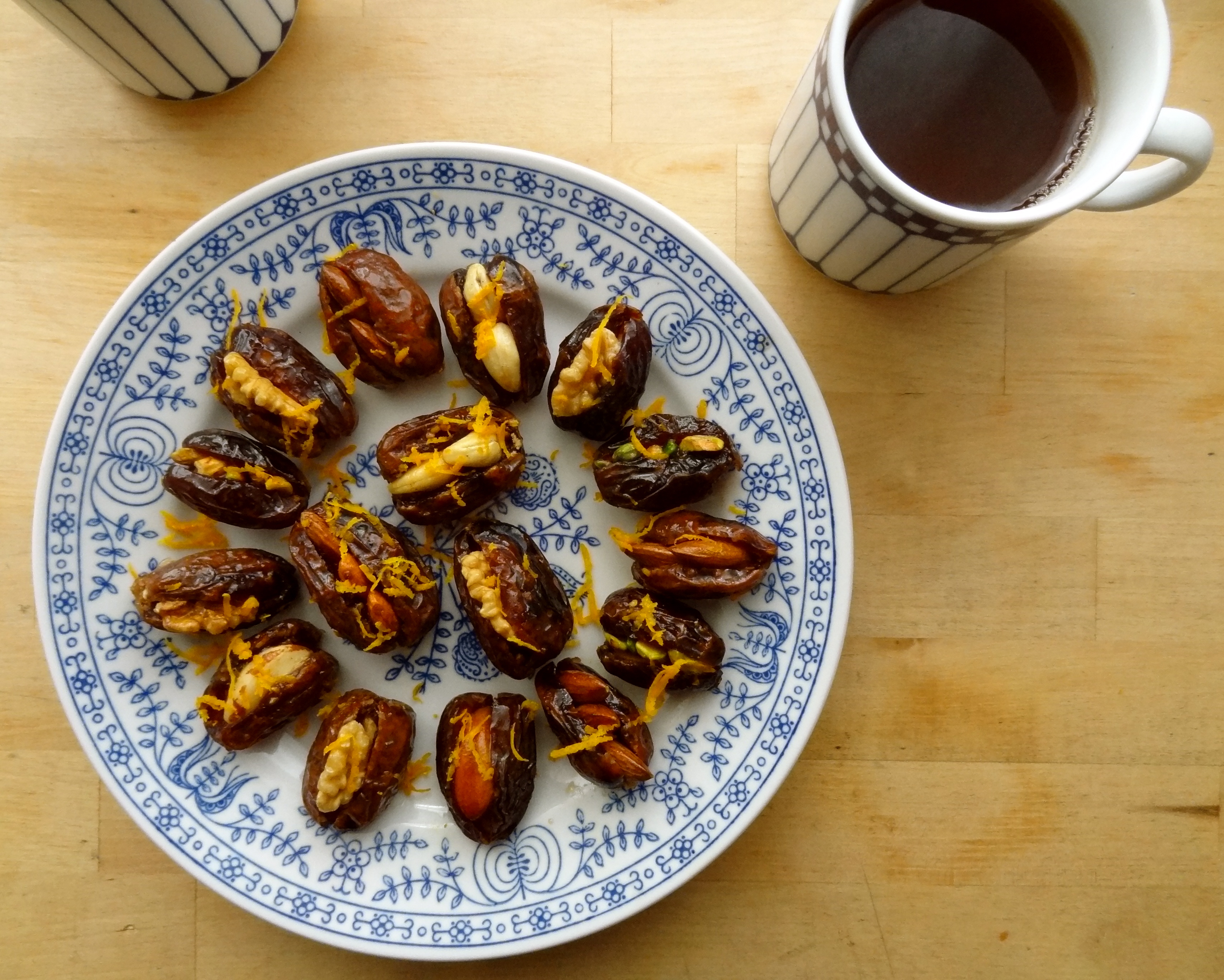
When I lived in Jordan, one of my beloved pursuits was to visit the sweet stores, especially during Ramadan and Eid.  There were so many delicacies on offer, tantalizing combinations of dried fruits and nuts, usually with an aromatic hint of rose or orange blossom.  It was here that I first encountered stuffed dates and I was instantly charmed as they’re my kind of sweetie treatie – naturally healthy and bursting with super sweet flavor.  This is my take on stuffed dates, which are the quintessence of good times and celebration.  Eid Mubarak!

Orange Blossom Stuffed Dates

16 – 24 Medjool dates

A selection of nuts:  Walnuts, macadamias, almonds, pistachios, Brazil nuts, cashews…

The juice and zest of an orange

1 tablespoon of honey or agave

1 tablespoon of orange blossom water *

1/2 a teaspoon of cinnamon

In a small saucepan, slowly bring to boil the water, honey, orange-blossom water and cinnamon.  Allow to boil for a couple of minutes, stirring often, then set aside to cool. Split the dates open and remove the pit.  Set the nuts into the dates, with the nuts resting lengthwise.  With a pastry brush, generously glaze the stuffed dates with the syrup.  Pop in the fridge for at least 30 minutes for the glaze to set.  Arrange on a platter and sprinkle the orange zest over the stuffed dates.   Enjoy at any time of the day or night, with rose tea, coffee or as a celebratory sweetie-treatie.

Note:  There will probably be some left over syrup, which makes a great accompaniment to yoghurt.

* Orange blossom water can be found at all good delicatessens or Middle Eastern food retailers.

* Wunder Bars *

Standard

One of the things that I love the most about spending the summers in Berlin (apart from avoiding the New Zealand winters) is the access to inexpensive, organic whole foods. Clearly, I like to dabble in ancient grains and when I go to a supermarket or even a drugstore here, the aisles are packed with interesting and über-healthy types of flour, cereals, grains and vegan products.  Here, I really am in super foodie heaven.   A product that I’ve been experimenting with lately is puffed amaranth.  If I’m not having it for breakfast simply with fruit, milk and a touch of honey, I’m adding it to my super fruity Bircher muesli recipe for extra goodness.  Amaranth is a silent-type super food that you may have spotted hanging about on the bottom shelf at your local health food store.  However insignificant it may appear, it really does work in extraordinary ways.  Amaranth is actually a seed or “pseudo-grain”, which has been a staple food in numerous cultures for centuries.  In fact, the Aztecs regarded it as having supernatural powers and used it in religious ceremonies by forming a paste out of amaranth and honey and creating an image of a particular god they were worshipping.  Once formed, the image of the god was broken up and shared between the worshippers to eat.  This “food of the gods” is gluten-free, very high in protein and easily digested.  It is also rich in vitamins, containing vitamin A, vitamin B6, vitamin K and folate.  Minerals present include manganese, copper, calcium, iron, magnesium, phosphorous and potassium.

Another super food that I’ve encountered in Berlin is the aronia berry, or chokeberry, as it is sometimes referred. The aronia berry is a native to North America and is being hailed for its amazing super food properties.  Research has suggested that presently it has the highest concentration of antioxidants in any fruit.  Aronia berries also have an extremely high concentration of flavonoids, which help the body fight against disease.  They are known to improve circulation and have a good dose of quinic acid, which can prevent urinary infection – helpful and nutritious!

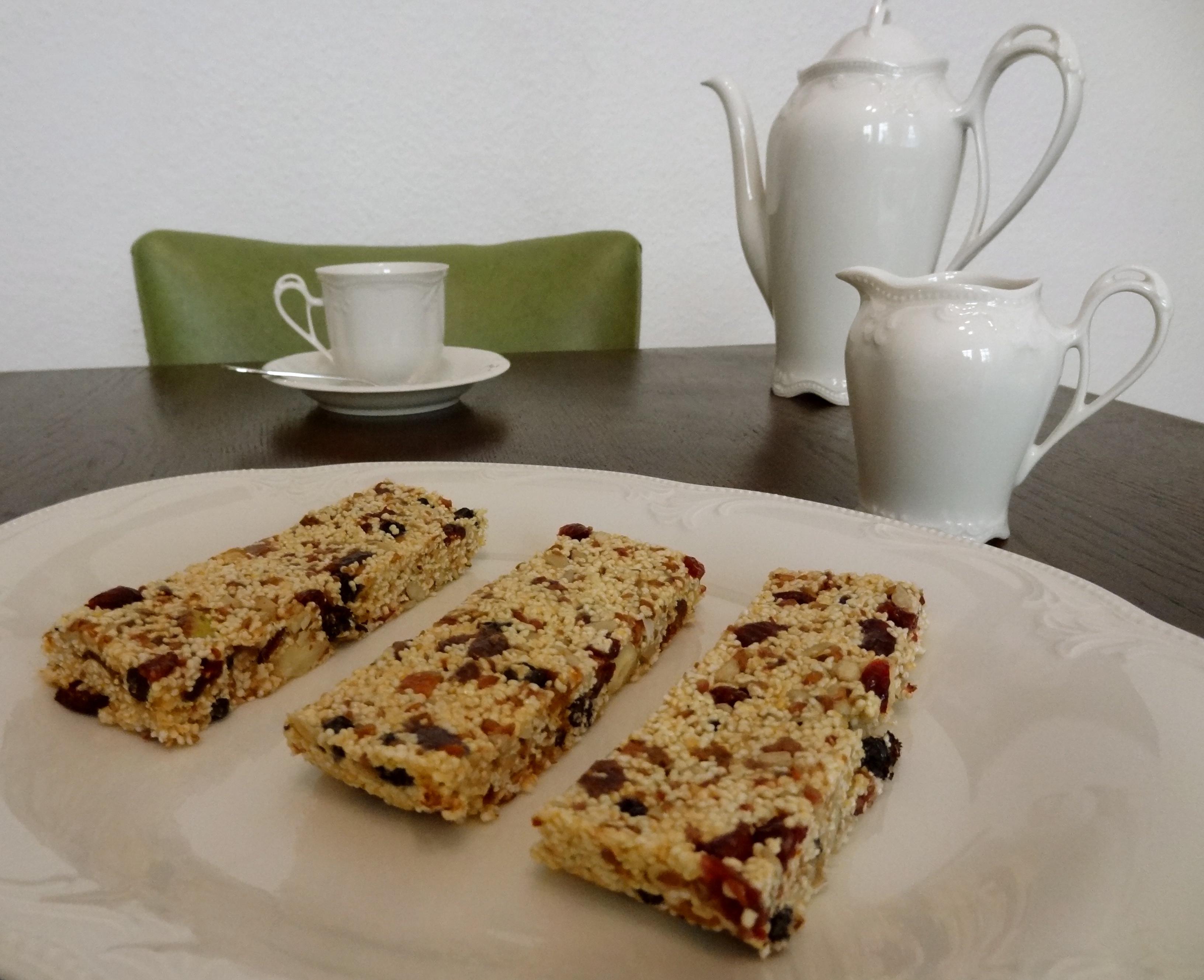
So, these wunderbars really are a wunder.  They are prepared in a flash and are generally made up of ingredients that you would have lying about in the nether regions of your pantry (with the exception of the aronia berries).  They also provide you with extreme nutrients to ensure that you power through the afternoon without resorting to making evils at your irritating colleague, or Beau, who you’ve been living in a shoe box with for far too long.

Wunderbars

2 1/2 cups of puffed amaranth

1/4 of a cup of loosely ground flaxseed

1/4 of a cup of dates, finely chopped

1 cup of dried super fruits: cherries, goji berries, raisins, aronia berries, blueberries…

1/4 of a cup of sunflower seeds

1/2 a cup of nuts:  almonds, pistachios, cashews, Brazil nuts…

1 teaspoon of cinnamon

A large pinch of ground Himalayan rock salt

1/2 a cup of agave or honey

1/2 a cup of tahini

3 tablespoons of coconut oil

1 teaspoon of vanilla extract/vanilla paste

Mix all of the dry ingredients together in a large bowl.  Heat the wet ingredients in a saucepan until a liquid consistency is reached, right before boiling point.  Combine the wet ingredients with the dry ingredients until it resembles a divine mass of goodness.  Push into a form and pop into the fridge for a few hours to solidify.  Cut into bars and eat for breakfast, lunch or simply when you’re having a “moment”.  Keep refrigerated for the perfect wunder bar.

* Super Fruity Bircher Muesli *

Standard

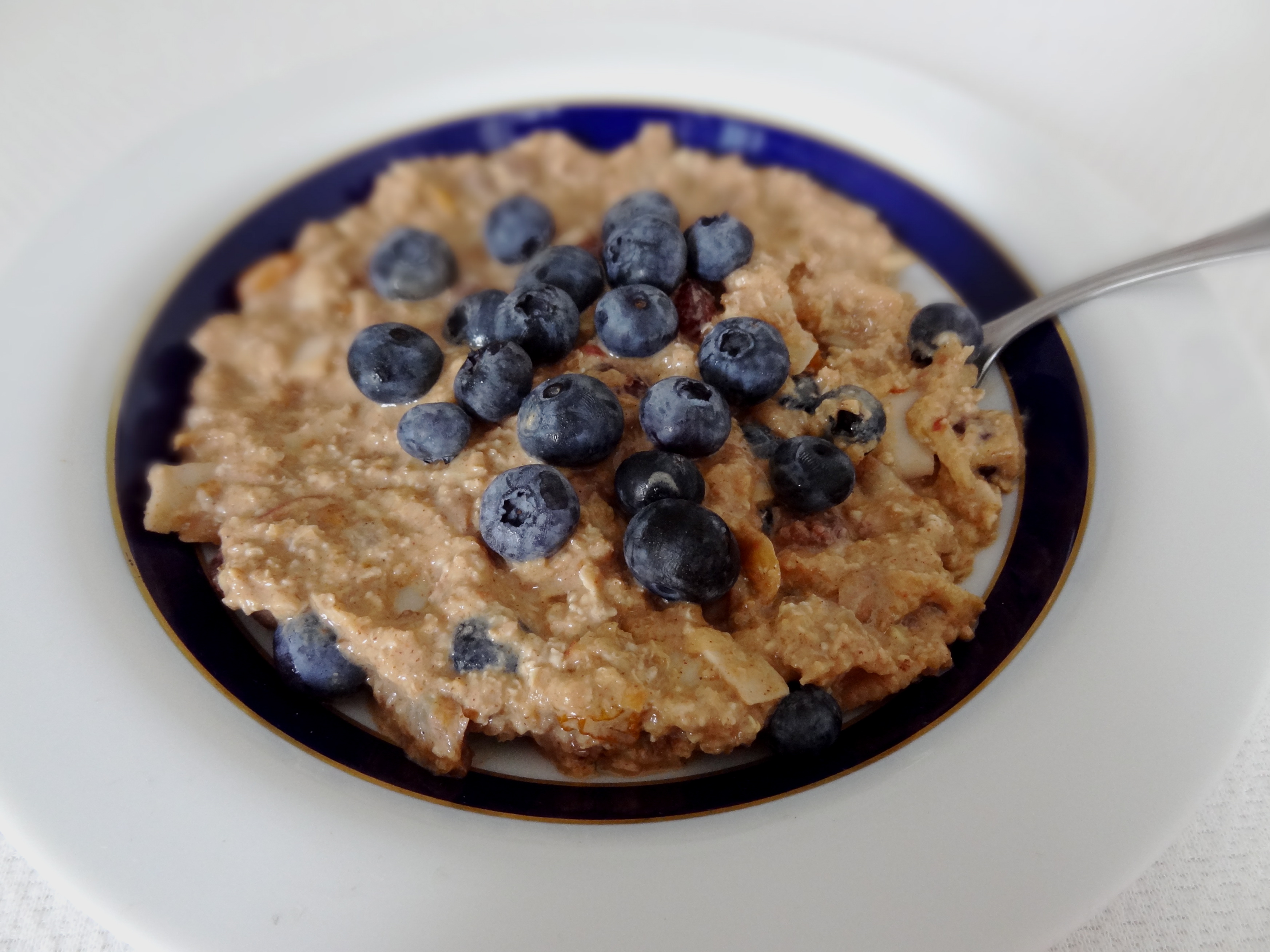
Bircher muesli is one of the best ways to start the day – naturally sweet and oh so nourishing, it really does give you the sustenance to skip out the door.  Bircher muesli was created circa 1900 by a Swiss German physician Maximilian Bircher-Benner to nurse his patients back to health the old fashioned way – with a hearty injection of nutrients derived from raw food.  It is essentially a combination of oats, fruit and nuts, soaked in juice overnight.  There are many variations of the original and the way that I enjoy mine is super creamy, full of spice and packed with plumped-up super fruit.  Bircher muesli is also very practical – it’s simple to prepare at night whilst cooking your dinner and is easily transported if you are taking a container full to work or, much preferably, the park to eat.

Oats are a nutritional wunderkind, providing serious nutrition to many, many people all around the world, mostly on week days.  Oats contain high levels of both soluble and insoluble fibre, which is good news for digestion as it keeps the digestive track cleansed and in tip-top shape and also keeps you full for longer.  Bircher muesli is also heart smart, with the oats and sunflower seeds providing cholesterol-lowering goodness from manganese, selenium and magnesium.  The high protein content in oats, sunflower seeds and amaranth coupled with the antioxidant hit from the super fruit make this a power breakfast fit for both Olympic athletes and generally awesome athletes, like ourselves.

Super Fruity Bircher Muesli 

1 cup of rolled oats

1 apple, cored and grated

10 dates, roughly chopped

1/2 a cup of dried super fruit of your choosing: goji berries, cherries, raisins, sultanas, cranberries

2 tablespoons of sunflower seeds

2 tablespoons of coconut chips or thread coconut

Cinnamon to taste *

1/2 a cup of yoghurt

1 1/2  cups of fresh apple juice (3 apples, juiced)

The juice of half a lemon

To serve:  2 tablespoons of puffed amaranth and extra fruit (blueberries work especially well).

Mix the ingredients together in a bowl and leave to soak overnight.  Stir in puffed amaranth to serve and garnish with extra fruit.  Dig in.

Serves 2.

* I usually add about 1 teaspoon of cinnamon but I prefer mine extra spicy.

* Lemon Chia Curd *

Standard

Lemon curd is surely one of the finer things on earth – put simply, it’s silky, smooth sunshine in a pot.  With the addition of chia, this lemon curd is decorated with tiny, speckled seeds which provide a rich source of antioxidants and give a delightful twist on an old classic.  It is so versatile that when I have a batch in the fridge, it is likely that I’ll have it on toast for breakfast, on crackers or mixed into yoghurt as an afternoon snack and featured somewhere in a dessert that evening.  The truly brilliant thing about this recipe is that you can have the zesty, creamy goodness sans unnecessary fat and refined sugar, which is usually present in traditional lemon curd recipes.  It is seriously simple – eggs, lemons, honey and the shining super food star, chia.  The chia seeds provide a dreamy texture and gelatinous quality to the curd which butter would usually achieve.

Chia is a relatively new product on our shelves, but has been cultivated and used in a variety of ways in South America for centuries.  It comes from the plant Salvia hispanica and is a member of the mint family.  Chia is a rich source of omega-3 fatty acids and unlike flaxseeds, does not have to be ground to enable nutrients to be absorbed by the body.  Chia seeds are also a good source of fibre, magnesium, copper, iron, zinc, calcium and niacin.  When mixed with liquid and allowed to sit for 20 – 30 minutes, chia forms a gel which can be used as a vegan and gluten-free thickening agent.  Basically, you can add chia seeds to anything you like – sprinkled on salads or porridge, as an energy-boosting ingredient to a smoothie or ground up in baking.

Lemon Chia Curd

2/3 of a cup of lemon juice (about 5 large lemons)

The zest of two lemons

1/3 of a cup of good quality honey

5 free-range egg yolks

1 free-range egg

1 teaspoon of vanilla paste

1 heaped tablespoon of chia seeds

Place all of the ingredients into a thick-bottomed saucepan and whisk* together at a low – moderate heat.  Whisk constantly until the mixture thickens, usually about 5-6 minutes or when the mixture sticks to the back of a spoon.  Take off the heat, transfer into a vessel and allow the mixture to set in the fridge for 1-2 hours.  The lemon chia curd will keep well in the fridge for up to two weeks, though it will most probably be snaffled in the first couple of days.  Serve with anything you like, the possibilities are truly endless.

* Note:  I’ve found that using a silicone whisk as opposed to a metal whisk makes for a far superior tasting lemon chia curd.

* Kale and Chard with Avocado *

Image

Now this may look like a rather humble dish, but I assure you it is anything but.  I’m all about making vegetables the star of a meal and this dish truly showcases kale and chard as the main event, with avocado contributing a rich serving of nature’s butter. A way that I like to enjoy this dish is on toast with a generous serving of beetroot hummus, which makes a simple, nutritious dinner for busy people.  Add a poached egg on top for extra sustenance.

Kale is a stellar vegetable that is part of the brassica family (which also includes broccoli, cauliflower and Brussels sprouts).  It rates highly in the area of carotenoids and flavonoids, the antioxidants which protect cells from free radicals.  Kale is high in fibre, with one cup providing 20% of the recommended daily dose and also contains a high quantity of vitamin C, vitamin A and manganese.  Kale also has the ability to lower levels of cholesterol and through the steaming process, this is further enhanced.  The fibre components in kale work more effectively binding together with bile acids in the digestive tract when they’ve been steamed. As a result of the binding process, it is easier for bile acids to be excreted and viola! your cholesterol levels are lowered.

In Dunedin you can buy kale at the Saturday Farmers Market and is currently in season, as is chard and avocado.  Or if you are extra-amazing, grab some from your garden that you prepared earlier and get chopping.

Kale and Chard with Avocado

A big bunch of kale (any kind you wish – green, curly, purple, Russian)

An even bigger bunch of chard (also known as silver beet or Swiss chard)

Half an avocado, diced

A generous sprinkle of Himalayan rock salt

A dash of pepper

Juice of half a lemon

Heat a pan to a moderate temperature.  Wash kale and chard thoroughly, remove stalks and cut in a rustic fashion.  Once pan is heated, add the kale and chard and put the lid on.  Steam for a couple of minutes until wilted.  Season with salt, pepper and lemon juice.  Transfer to a serving bowl and add diced avocado. Enjoy own its own or as an accompaniment to fish or meat.

* Beetroot Hummus with Thyme and Honey Roasted Carrots and Broccoli *

Image

I just have to look at this dish and I feel energised.  Beetroot hummus, thyme and honey roasted carrots and broccoli florets make a delightfully colourful appetiser to entertain a crowd and ensure that your loved ones get an antioxidant hit.  Hummus is such a practical, nutritious food which originated in the Middle East and has spread far and wide.  In the last 8 years or so, the hummus market has exploded in New Zealand, with many new players and numerous variations of this humble dip.  However, why pay so much for a super cheap food that you can make so easily at home?  And what about those little plastic containers which have to be shipped off to China to supposedly be recycled?  Not to mention all of the additives, preservatives and whateverives which are present in the store-bought varieties.  Take control of your diet, grab a food processor and get stuck in.

You can play with this recipe as you like.  If you want to reduce the oil content, or omit it altogether, add an equal quantity of water.  Or if you have a juicer, juice a beet or two, add it to the mix and watch the colour brighten. I am a firm believer in adding good quality fats to your diet where possible and there are some über-healthy fats in this dish to make your skin glow and hair glisten.  Olive oil, sesame oil and tahini provide a wonderful combination of vitamins E and A, calcium and carotenoids, which protect your cells from the damaging effects of free radicals and enhance the functioning of your immune system.  Broccoli, carrots and beetroot also provide a hearty dose of folate, vitamins A, K and B6, as well as ample dietary fiber to aid digestion and ensure optimum health and vitality.

The beautifully designed ceramics featured in the photo are available from Whiteroom – Dunedin’s design destination.

Beetroot Hummus

3-4 beetroots, cubed

A tablespoon of sesame oil

A sprinkle of Himalayan rock salt

A sprinkle of pepper

A cup of chickpeas, cooked and cooled (or from a can, rinsed well)

3-4 cloves of garlic, chopped

3 tablespoons of tahini

1/4 of a cup of extra-virgin olive oil

A teaspoon of cumin

The juice of a lemon

The juice of 1-2 beetroots or cold water

Preheat oven to 190ºC. Place the cubed beetroot, himalayan rock salt, pepper and sesame oil in a roasting dish and bake for 40 minutes until cooked.  Place all of the ingredients in a food processor and whiz.  Extra oil, water or beetroot juice may be added to obtain the desired consistency.

Thyme and Honey Roasted Carrots and Broccoli

3-4 large carrots, sliced diagonally

A tablespoon of honey

A tablespoon of extra-virgin olive oil

The juice of half a lemon

A few sprigs of thyme, stems removed

A sprinkle of Himalayan rock salt and pepper

Place carrots in a separate roasting dish.  Add the honey, olive oil, thyme, lemon juice, salt and pepper.  Roast carrots for about 4o minutes until nicely cooked. Blanch a head of broccoli which has been chopped into florets.  Arrange beetroot hummus, thyme and honey roasted carrots and broccoli on a platter and serve.